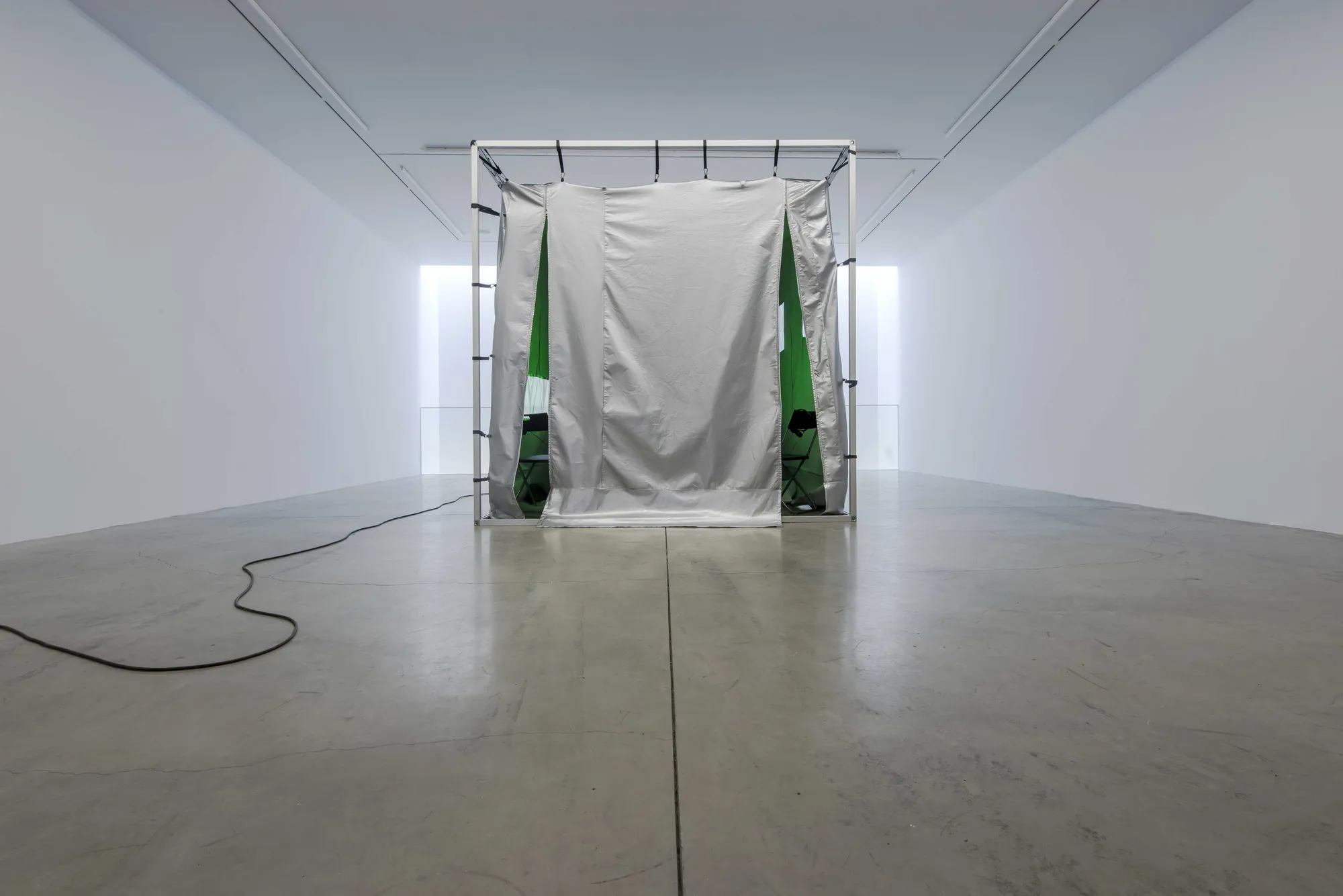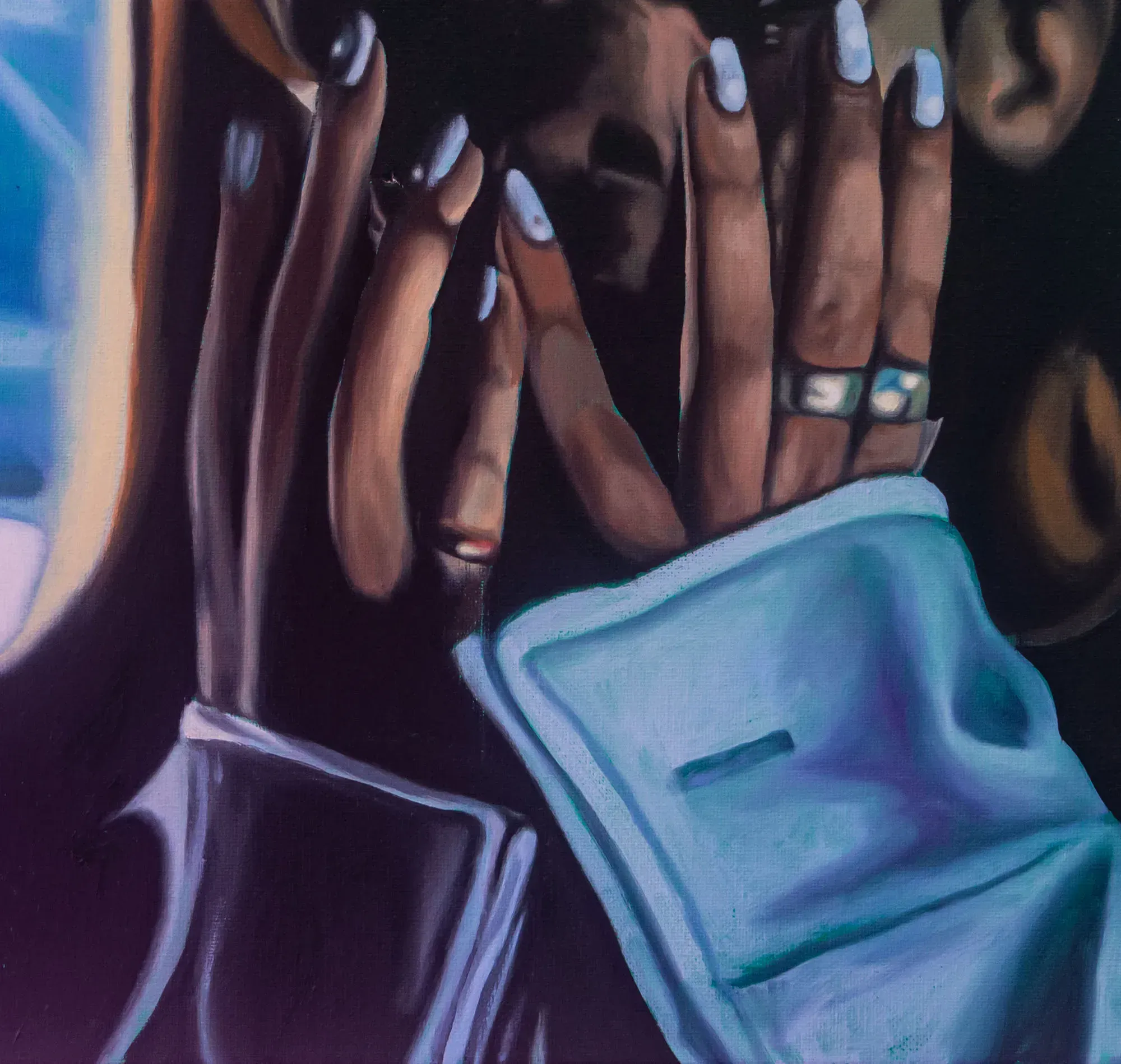
Bora Akıncıtürk’s solo show, A Normal Life, from February 1 to March 2, 2024. Born in Ankara and currently based in London, the artist is concerned with the visual presentation and ease of access to information gathered from the internet, which has had a profound impact on our daily lives. Through his artwork, he explores the ways of life and expression in the post-truth digital era. Infusing humour into his visual narratives, Akıncıtürk delves into critical issues such as identity politics, anonymity, authorship, and the transmission of information. Thus, his exploration is uniquely framed through the perspective of his generation, era, and daily experiences.
The exhibition is accompanied by a ballad written by Mehmet Ekinci, which explores the concepts and themes that Akıncıtürk focuses on in the context of the works in the exhibition. Like a chiropractor struggling to reattach a dislocated joint, Parabiography of a Normal Life attempts to hold together the points of connection between the artist's life and his works, sometimes with precise movements and sometimes by missing the mark. Consisting of 10 stanzas and 41 verses, this fictional text, which is a lament for the impossible independence of the works that emerge after the creation process, becomes an observer who, after entering and leaving the artist's inner world with a hand-held camera with the flash switched on, pours out semi-real insights.
“Being in the flow”: From a spiritual desire to bright small screens
The phrase "being in the flow" has become a modern adage and a popular way of life mantra. We are repeatedly advised to align ourselves with this concept to be present in the moment and achieve mental and physical tranquillity. Being “fluid” takes on an even greater significance, a natural outcome of an era marked by increasing individuality and freedom, where ideological, political, identity and gender discourses are gaining prominence. While we live far beyond the definition of a "fluid modernity" as described by Zygmunt Baumann, electronic technologies have already replaced the old structures of power and surveillance. The so-called spaces of individual freedom provided by social media and other networks have persuaded everyone to believe in the limitlessness of choice, the abundance of knowledge, and the ability to be as inconspicuous as they like, even if they are the master of the keyboard. These days, when the term "disinformation" is used interchangeably with "information," it is easy to be conditioned by the possibilities afforded by the internet, but it is also possible to find the right paths as one navigates through the heaps of information. However, it is true that our daily rituals, business strategies, what to buy, what to talk about, what news to follow, and many other things are now dictated by the digital "flow" we see on an electronic device amid bright white lights.
“Maybe the most interesting aspect of the Internet as archive is precisely the possibility of decontextualization and recontextualization through the cut-and-paste operations that the Internet offers to its users.”[1] says Boris Groys. On similar lines, Bora Akıncıtürk uses the power of search engines, social media accounts and networks to create a unique image archive and present a narrative. As he pulls images from their own spaces and constructs them with new stories, he tries to anonymize his own painterly identity, akin to the anonymization that the internet provides to the individual. While reproducing realist paintings from different sources, even stock images, found and collected through various audio-visual social networks such as Instagram, Twitter, Tumblr, and SoundCloud, he occasionally incorporates his symbols, colours, or writings on the canvas. While trying to become anonymous by distancing himself from the painter’s creative subject, style, and aura, he feeds on anonymous images whose creators or photographers are often unknown. Thus, as the source of the imitated image remains uncertain, it creates doubt about its origin. A topic, a film, book, thought, or character that interests him is enough to send him into the depths of search engines; sometimes, another piece of news or information he encounters in search of an image catches his attention, in other instances, he finds an account that comes close to his ideas and shares the same world and starts following it. However, even if Akıncıtürk tries to be anonymous by tracing the images, he inevitably reveals a narrative about his mind and the flow of his screen. With the approach of a curator rather than a creator, the artist puts the pieces together to create a puzzle where we can reinterpret the images we are mostly familiar with. In fact, one of his ultimate objectives is for the audience to be left in the dark about the subject matter, the author, or both when the works are completed. In this process, it is also quite exciting to imagine the search history on his computer, to imagine which image Akıncıtürk searches for and with which expressions, and the possibility of accessing what his mind collects from the flow of images and how he chooses them.
The Leftovers of a Normal Life: Planet of Images
The title of the exhibition, A Normal Life, contains a duality about the period we are living in. Being normal, or identifying anything as normal, is a contentious and difficult issue today, possibly more than ever before. In a period when the lynch culture is so violent, individualization, definitions and freedom of expression sometimes push the limits and everyone's sensitivity is heightened, "normal" can still be easily used to describe any day, a period of time or an everyday, non-extreme event when it is not used on individuals. While touching on identity, gender, norms, social changes, and forms of expression, Akıncıtürk reflects his passion for collecting, accumulating, thinking, and transmitting, which is his own normal.
10 oil paintings on canvas are installed in the gallery space inspired by the idea of the curatorial display of Norwegian artist Fredrik Værslev at a group exhibition last year where 10 monochrome paintings made in the last 10 years were exhibited. The show also includes an installation first exhibited by the artist in 2017. The first version of this work, A New Hope, shown at Alyssa Davis Gallery, consisted of a Union Jack flag rising from a large plant pot suspended from the ceiling by yellow chains and small installations. This hybrid flag, with its multiple textile layers, delimited the potted soil, defining it as a zone where national ideologies converge. This time, the artist uses the Turkish flag in his installation, leaving the associations of a flag image free but also allowing us to read it in a different context. The artist, who usually constructs ideological, political, or intellectual symbols of the current global cultural era in diverse scenes, here, too, strips the image of its local definition and redefines it in a new political context, raising questions about the violent or oppressive aspects of any totalitarian ideology.